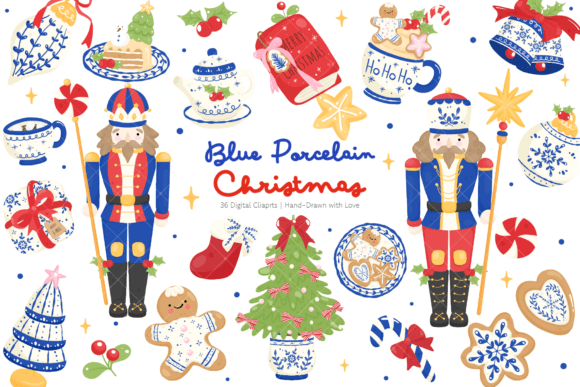
Blue Porcelain Christmas Clipart
A Designer’s First Glance: Delicate, Timeless, and Quietly Confident
When I opened Blue Porcelain Christmas Clipart, the first thing that struck me wasn’t just the color—it was the silence in the lines. Inspired by Delft blue porcelain, this set carries that same restrained elegance: clean outlines, balanced negative space, and motifs that breathe—think stylized holly sprigs, slender bells, tiny birds perched on branches, and subtle star motifs—all rendered with a hand-drawn grace that avoids fussiness. It doesn’t shout “Christmas.” It whispers it, like a well-worn teacup passed down through generations. That mood is its biggest strength—and its most important constraint.
Real Project Test: Embroidering a Linen Tea Towel for a Boutique Holiday Launch
Last week, I prepped a small batch of holiday kitchen towels for a local maker friend’s Etsy shop. She wanted something refined—not cutesy, not glittery—just warm, heirloom-feeling, and unmistakably handmade. We chose a natural linen blend, medium-weight, with visible weave texture. I digitized one of the smaller motifs from Blue Porcelain Christmas Clipart (a single bell with trailing vine) as a 3.2” tall satin-stitched emblem, centered near the towel’s hem.
The result? Instant cohesion. The design held up beautifully—even with linen’s slight irregularity—because its outlines are confident but not rigid, and its internal details aren’t overworked. Customers responded to how “calm” and “intentional” it felt. Not flashy. Not trend-chasing. Just quietly special. That’s where Blue Porcelain Christmas Clipart shines: in products people want to keep, gift, or display year after year.
Where It Excels (and Where It Asks for Thoughtful Handling)
This isn’t a bold, high-contrast clipart set built for quick heat-transfer decals. It’s an illustration—a graphic—designed for subtlety and craft integrity. Here’s how it plays out across real embroidery contexts:
- Custom apparel & sweatshirt embroidery: Works best on structured, medium-to-heavy fabrics—cotton twill, fleece-backed sweatshirts, canvas jackets. Avoid ultra-thin tees unless you reduce size and simplify stitch density. The fine linework reads clearly only when stabilized properly.
- Baby embroidery & nursery decor: Ideal. Its gentle scale and lack of aggressive detail make it perfect for onesies, burp cloths, and muslin pillow covers—especially when stitched in soft pastel threads against ivory or oatmeal fabric.
- Embroidered patches & tote bag design: Excellent for minimalist branding. Stitched cleanly on denim or canvas, it reads as artisanal—not mass-produced. Pair it with a simple serif font for a cohesive boutique label.
- Hats & curved surfaces: Use only the simplest motifs (e.g., a single sprig or star). Avoid anything with tight corners or nested shapes—they’ll distort on a cap’s crown or visor curve.
- Dark fabric & layered garments: Requires careful thread color choice. Navy or charcoal linen? Go for ecru or light cerulean thread—not stark white. Test contrast in natural light. On darks, the delicacy of Blue Porcelain Christmas Clipart can vanish if thread lacks enough tonal lift.
What This Design Says About Your Finished Product
When customers see Blue Porcelain Christmas Clipart stitched onto a handmade item, they’re subconsciously reading your values: attention to heritage, respect for material, and confidence in restraint. It elevates a simple tea towel into a curated gift. It makes a baby blanket feel like a keepsake—not just a prop. For Etsy sellers and small shop owners, that translates directly to perceived value, repeat buyers, and word-of-mouth trust. But—and this matters—it only delivers that impact if executed with care. A rushed stitch-out on unstable fabric, poor stabilizer choice, or mismatched thread will flatten its elegance into mere “faintness.”
Practical Notes Every Embroidery Designer Should Run Through
Before cutting fabric or loading your machine, treat Blue Porcelain Christmas Clipart like a sketch—not a finished blueprint:
- Test on scrap fabric first, using the exact stabilizer and thread you’ll use in production. Linen? Try tear-away + light cut-away. Knit? Switch to cut-away + topping.
- Review stitch density. These illustrations weren’t created as machine embroidery files—so if you’re digitizing them yourself, avoid heavy fill stitches in narrow areas. Let the outline do the work.
- Inspect small details at 200% zoom. That delicate curl on the bell’s clapper? It may disappear at 2” tall. Simplify or omit if needed.
- Check black-and-white mockups. Does the motif retain shape and balance without color? If not, adjust spacing or weight before stitching.
- Confirm licensing for commercial use. Since this is an Illustrations bundle (not a pre-digitized embroidery file), verify whether redistribution or sale of finished embroidered goods is permitted under its terms.
- Compare light vs. dark backgrounds. What reads as serene on ivory may read as indecipherable on navy—unless you adapt thread tone thoughtfully.
Final Thought: Elegance Isn’t Automatic—It’s Earned in Execution
Blue Porcelain Christmas Clipart won’t carry your project for you. It doesn’t promise viral appeal or instant sales. What it offers is rare: visual quietude with quiet authority. In a market saturated with loud, fast, algorithm-friendly designs, this set gives you permission—and material—to slow down, choose meaning over momentum, and build something that feels truly made, not just assembled. Whether you’re stitching a single personalized gift or launching a holiday collection for your craft business, it rewards patience, precision, and respect for the hand behind the hoop. That’s not just design judgment. That’s professional instinct.