One Continuous Line Design of Hand
As a designer who’s stitched hundreds of custom projects—from boutique baby onesies to Etsy best-selling tote bags—I opened One Continuous Line Design of Hand expecting simplicity. What I found was something more intentional: quiet confidence in line, subtle modernity in gesture, and real potential for thoughtful handmade products.
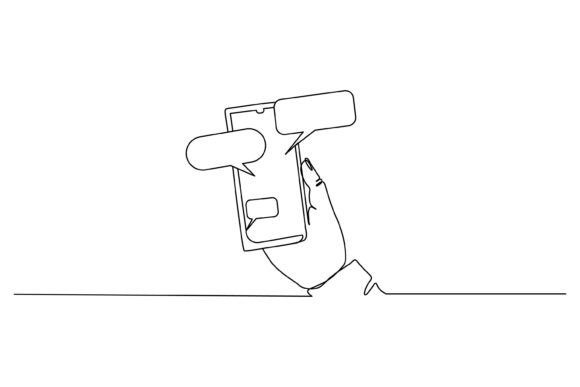
The design shows a hand holding a smartphone with a messenger app icon visible on screen—rendered in a single unbroken stroke, no fills or gradients, just clean contour. Decorative flourishes orbit the wrist and frame the device lightly. It’s drawn on white, so it reads as both illustration and embroidery-ready outline. At first glance, it feels calm, contemporary, and quietly human—not flashy, not gimmicky. That matters when you’re building brand consistency for a small shop or choosing a design that’ll live on a nursery pillow for years.
A Real-World Test: Embroidering This on a Linen Tea Towel
Last week, I used One Continuous Line Design of Hand for a limited-run kitchen towel collection—linen blend, medium weight, hemstitched edge. I digitized it myself (as I often do with vector-based illustrations like this) using a running stitch base with light satin accents around the phone screen and wrist details. The result? Crisp, legible, and tactile without overwhelming the fabric’s natural texture.
Customers responded strongly—not to “cute tech art,” but to the warmth of the gesture. One buyer wrote, “It looks like someone reaching out—not scrolling, not tapping, but connecting.” That resonance is rare in digital-age embroidery designs. It’s why One Continuous Line Design of Hand works so well for personalized gifts, wedding favors, or therapist/teacher appreciation items—it carries emotional weight without needing words.
Where It Shines (and Where It Needs Care)
One Continuous Line Design of Hand excels in low-density, high-intent applications:
- Custom apparel: Works beautifully on crewneck sweatshirts (left chest), relaxed-fit tees, and unstructured caps—especially when stitched in matte cotton or tonal rayon thread.
- Embroidered patch: Clean lines translate cleanly to twill or felt backing; minimal stitch overlap means less bulk and better flexibility on jackets or backpacks.
- Baby embroidery: Gentle scale and open composition avoid visual clutter—ideal for onesie sleeves or burp cloth corners where detail can’t compete with softness.
- Holiday embroidery: Paired with minimalist typography (“Hello, 2025” or “Stay Connected”), it adds quiet relevance to seasonal kitchen towels or ceramic mug wraps.
- Digital embroidery file use: Since it comes in EPS and SVG, it’s easy to resize without distortion—critical when prepping printable mockups for Etsy listings or client approvals.
But here’s what I watched closely—and recommend you do too:
- Small hoop sizes: The full composition fits comfortably in a 4×4 hoop, but the phone screen detail shrinks fast below 3 inches wide. If stitching for a child’s cap or tiny apron pocket, simplify the screen icon or omit it entirely.
- Textured or stretchy fabric: On terry cloth or lightweight jersey, stabilizer choice is non-negotiable. Use cutaway + tear-away combo to prevent puckering along the continuous line’s long curves.
- Dark fabric: The design relies on contour contrast. On charcoal or navy, test thread color carefully—medium gray or heathered ecru often reads truer than stark white.
- Curved surfaces: For caps or curved pillow seams, reduce stitch density slightly and avoid tightening the final tension too much—the line should flow, not snap.
What It Adds to Your Finished Product—Beyond Aesthetics
Using One Continuous Line Design of Hand isn’t just about placement or stitch count. It subtly elevates perception:
- Handmade product value: Its restraint signals intentionality—customers associate clean line work with craftsmanship, not mass production.
- Brand consistency: As part of an Illustrations collection, it pairs naturally with other minimalist graphics (a single leaf, a folded paper crane), helping craft businesses build cohesive design assets.
- Giftability: Because it avoids dated tech tropes (no cracked screens, no cartoonish emojis), it stays relevant across seasons and recipient ages.
- Buyer engagement: On Etsy or Instagram, this design stops scrollers—not with loud color, but with quiet familiarity. People recognize the gesture before they read the description.
Practical Designer Notes Before You Stitch
Before committing to a full run—or listing your first One Continuous Line Design of Hand-embellished item—do these five things:
- Test the design on scrap fabric matching your final product’s weight and weave.
- Check thread color contrast on both light and dark backgrounds—don’t assume black-on-white is always strongest.
- Review stitch density in your embroidery software: aim for 8–12 stitches per cm on curves to keep lines smooth but breathable.
- Confirm your hoop size aligns with the design’s natural scale—especially if adapting it for baby embroidery or commercial embroidery batches.
- Verify licensing terms: since this is a Graphics asset sold as EPS/SVG/JPG, confirm whether resale of finished embroidered items is permitted, and whether digital redistribution (e.g., as part of a design bundle) is allowed.
Bottom line? One Continuous Line Design of Hand isn’t a trend-chasing graphic. It’s a quietly versatile, emotionally grounded Illustration—one that earns its place on a handmade sweatshirt, a therapist’s waiting room pillow, or a new parent’s first embroidered tea towel. It doesn’t shout. It listens. And in today’s oversaturated craft market, that kind of quiet clarity is worth every stitch.