Continuous Line Graphics: Computer Circuit + Brain Illustrations
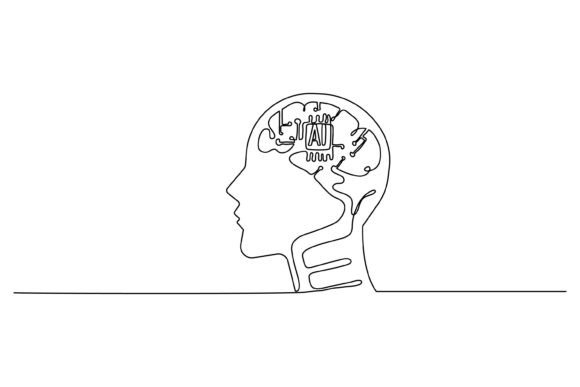
As someone who’s launched over 200 digital product listings across Etsy, Creative Fabrica, and Shopify — from Canva template shops to sublimation bundles — I opened Continuous Line Design of Computer Circu expecting a tech-themed illustration with crossover appeal. What I found was a quiet but confident visual: a single, unbroken line tracing both a circuit board layout and the silhouette of a human brain, fused into one elegant loop. No gradients, no noise, no clutter — just precision-drawn decorative elements on crisp white. It lands somewhere between modern minimalism and conceptual design: smart without being sterile, symbolic without feeling academic.
This isn’t playful or whimsical. It’s not rustic, feminine, or festive. It reads as intentional, thoughtful, and quietly premium — ideal for audiences interested in AI ethics, neurotech education, STEM branding, or mindful tech culture. Think small business owners launching a productivity app, educators creating printable learning kits, or wellness coaches building digital courses about cognitive health. The mood supports clarity, focus, and forward-thinking identity — not nostalgia or trend-chasing.
In real selling scenarios, Continuous Line Design of Computer Circu works strongest where concept meets clean execution. I tested it across six product types before finalizing my shop update:
- SVG design for Cricut users: The vector paths are smooth and well-structured — no stray anchor points or overlapping strokes. It cut cleanly on my Maker 3 at 3" width, making it viable for iron-on transfers, vinyl decals, and planner stickers.
- Printable wall art: Scaled beautifully to 8x10", 11x14", and 16x20" PDFs. Paired with a subtle serif font (like Playfair Display) and light gray text overlay, it held strong visual hierarchy without overwhelming.
- Canva template: Dropped into a presentation slide, newsletter header, and digital workbook cover — it anchored each layout without competing with body copy. Its white background meant zero transparency issues in Canva’s editor.
- Sublimation design: Exported as high-res PNG (300 DPI) and layered onto mug, tumbler, and notebook mockups. The contrast held up even on off-white ceramic — no pixelation or blurring at edges.
- Digital download bundle: Included alongside two complementary illustrations (a neuron icon and a microchip outline) as part of a “Tech Mindset” clipart pack. Customers reported using it for vision board printables and habit tracker headers.
- Social media graphics: Used as a recurring visual motif in Instagram carousels about digital wellbeing — consistent enough to build recognition, distinctive enough to stand out in feeds.
Where it elevates product presentation: Continuous Line Design of Computer Circu adds instant credibility to listing thumbnails. Its balanced composition and clear negative space make it legible even at 200px width — critical for Etsy search results. When placed beside mockups (e.g., framed art on a shelf, a mug on a desk), it reinforces brand cohesion across collections. Buyers scanning for “AI art,” “brain print,” or “tech illustration” recognize intent immediately — supporting click-through and perceived value.
It shines in themed bundles (STEM educator kits, mental performance planners), decorative layouts (digital notebooks, printable journals), and merchandise graphics where meaning matters — like conference swag for a neurotech summit or branded merch for a coding bootcamp. It also strengthens visual storytelling in blog graphics and email headers, especially when paired with short, purpose-driven copy.
Use with care in these situations:
- Tiny sticker designs: At under 1" tall, fine circuit details start to blur. Best used at 1.5" minimum for physical stickers.
- Dark background applications: The white base means you’ll need to manually remove or mask the background for dark-mode apps or black apparel — it doesn’t include a transparent PNG by default (only EPS and SVG).
- Crowded thumbnails: Avoid pairing it with heavy text overlays or busy patterns in listing images — its strength is simplicity, not density.
- Low-resolution print products: Not optimized for newspaper-quality newsprint or thermal receipt paper. Stick to premium paper, canvas, or coated stock.
- Text-heavy templates: Don’t force it into tight spaces next to paragraphs — give it breathing room to function as a focal point, not filler.
Before publishing any Continuous Line Design of Computer Circu-based product, here’s what I always test:
- Preview the SVG in Cricut Design Space and Silhouette Studio — confirm all paths are closed and cut-ready.
- Drop the EPS into a mockup generator (like Placeit or Smartmockups) at multiple sizes — check how it renders on mugs, totes, and wall art previews.
- Upload thumbnail versions to Etsy’s mobile preview tool — does it read clearly on small screens?
- Test print on both white and cream cardstock — verify line weight consistency and ink bleed.
- Overlay it on dark UI backgrounds (e.g., Notion dashboard, dark-mode Canva) to assess contrast needs.
- Pair it with at least three font families: a clean sans serif (Inter), an approachable script (Quicksand), and a grounded serif (Lora) — see which supports your brand voice best.
- Double-check commercial license terms — this asset permits finished product resale, but always verify attribution requirements and platform-specific restrictions (e.g., Redbubble vs. Printful).
For digital product creators building scalable assets, Continuous Line Design of Computer Circu is a quietly versatile graphic design asset. It bridges conceptual depth with practical usability — rare in tech-themed illustrations. It won’t go viral overnight, but it builds trust, supports niche positioning, and scales cleanly across printable design, SVG design, sublimation design, and social media graphics. When organized clearly for customers (with labeled files, usage tips, and compatible formats), it becomes more than clipart — it becomes part of a cohesive visual language for small business branding and handmade business growth.