Summer Svg Graphics: A Designer’s Real-World Embroidery Review
First Impressions: Light, Lively, and Handmade in Spirit
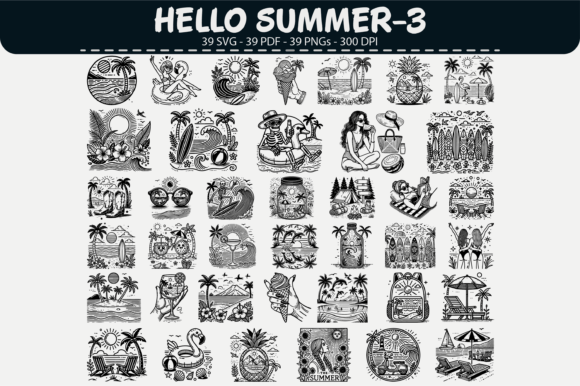
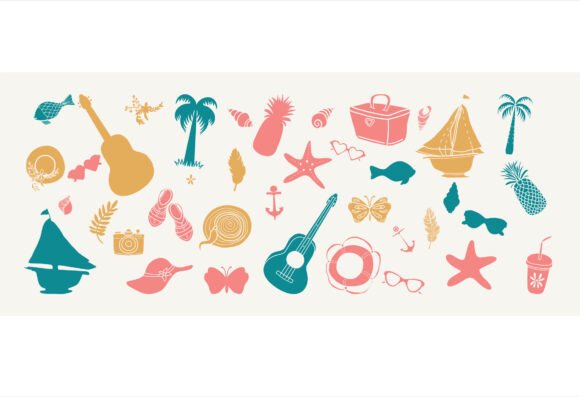
Opening Summer Svg Graphics, I immediately felt the warmth—not just of the tropical theme, but of its hand-drawn authenticity. This isn’t a sterile vector pack full of symmetrical icons; it’s a collection where wavy palm fronds have slight asymmetry, pineapple outlines carry gentle line weight shifts, and sunbursts taper like inked brushstrokes. As an embroidery designer who’s stitched hundreds of seasonal collections, I appreciate how that human touch translates directly to charm in thread. It reads as joyful but not childish, breezy but not flimsy—exactly the tone you want for a boutique tote bag or a personalized baby onesie.
What It Actually Stitches Like (Not Just What It Looks Like on Screen)
I tested Summer Svg Graphics on three real projects: a medium-weight cotton canvas tote, a loopback cotton sweatshirt, and a lightweight linen tea towel. On the tote? Gorgeous. The open-line elements—like the minimalist flip-flop or the single-line wave—stitched cleanly with running stitch, giving that effortless handmade look customers love. The fill-based icons (think the solid coconut or sun) held up well with moderate stitch density—no puckering, no thread breaks—especially when paired with a medium tear-away stabilizer.
On the sweatshirt, I chose a mid-sized tropical leaf motif centered on the chest. Because the design’s lines are intentionally varied—not uniformly thin or thick—it avoided that “digital flatness” many SVG-to-embroidery conversions suffer from. The curves softened naturally in satin stitch, and the organic edges gave depth without needing extra underlay. That matters: it means your custom apparel feels intentional, not templated.
The tea towel was the real test. Linen’s slub texture can swallow fine details, but the bolder pieces in Summer Svg Graphics—like the anchor or the oversized sunglasses—retained clarity. Smaller icons (e.g., the tiny starfish or cocktail glass) needed slight simplification before digitizing—I’d recommend scaling them up 15–20% for anything under 3" tall, especially on textured or loosely woven fabrics.
Where It Shines—and Where You’ll Want to Pause
Summer Svg Graphics excels in contexts where personality and warmth drive purchase decisions: personalized gifts, small shop products, and handmade product branding. Think embroidered pillow covers for a coastal Airbnb, custom aprons for a beachside café, or baby caps with a single palm silhouette. Its expressive line work reads beautifully at 2.5"–4.5" hoop sizes—ideal for most embroidered patch or tote bag design applications.
Use caution on: stretchy knits (pre-stabilize aggressively), dark fabric with light thread (some hand-drawn outlines fade unless you adjust stitch density or add split satin), and curved surfaces like cap fronts (simplify overlapping elements—like layered leaves—to avoid registration drift). Also, avoid using the most delicate linework—say, the fine rays around the sun—at sub-2" scale on thin fabric; those will vanish in wash or wear.
Design Assets That Support Your Craft Business
As an Etsy seller and craft business owner, I value assets that serve more than one purpose—and Summer Svg Graphics does. I used the same pineapple icon across three formats: as a standalone machine embroidery design on a denim jacket, as a layered applique design on a nursery quilt, and as a clean vector base for a printable mockup I sell alongside my embroidery files. That versatility is rare. It doesn’t force you into one style or scale—it invites adaptation.
Its cohesion also supports brand consistency. Whether you’re stitching a set of matching kitchen towels or building a summer capsule collection for your small shop, the shared hand-drawn rhythm makes everything feel like part of a thoughtful series—not a grab-bag of clipart.
Practical Notes Every Embroidery Designer Should Check
- Test first—always stitch a sample on scrap fabric matching your final project’s weight and stretch.
- Review stitch density—SVG files don’t include stitch data, so your digitizer (or software) must interpret line weight and spacing. Avoid overfilling open shapes meant to read as line art.
- Confirm hoop size compatibility—most motifs scale well, but tightly grouped elements (e.g., the “tropical trio” layout) may need repositioning for smaller hoops.
- Inspect small details—zoom in on corners and junctions. Hand-drawn vectors sometimes create micro-overlaps or stray anchor points that cause stitching hiccups.
- Try black-and-white mockups—this reveals contrast issues early, especially for holiday embroidery or wedding gifts where elegance matters.
- Match stabilizer to fabric—lightweight cutaway for knits, tear-away for stable wovens, and water-soluble for nap-free finishes on towels or baby items.
- Verify licensing—since this is a digital embroidery file derived from an Illustrations pack, confirm whether commercial use (e.g., selling finished custom apparel) is permitted before listing on Etsy or at craft fairs.
Final Thought: It’s Not Just Summer—It’s Storytelling in Thread
Summer Svg Graphics won’t replace technical precision when you need surgical detail—but that’s not its job. Its strength is emotional resonance. When a customer sees that slightly uneven sunburst on a handmade pillow cover, they don’t see a vector file. They see care. They see summer remembered, not stockpiled. For creative entrepreneurs, apparel decorators, and handmade shop owners, that quiet authenticity is what turns a simple embroidery project into a memorable finished product. Use it where joy matters more than perfection—and where your customers choose your work because it feels like theirs.